Before and after photos in Korea, and what they cannot show
Almost every “after” you are shown was photographed before the result existed. Here is the one before-and-after we can publish, why even that one is incomplete, and the dates at which each procedure actually stops moving.
Every published measurement of how a face or a body settles after cosmetic surgery says the same thing: the result takes months, sometimes years, to arrive. Almost every “after” photograph circulating in English was taken long before that point.
So the useful version of this page is not a gallery. It is the two questions that decide whether any pair of photographs means anything — how many days apart were they taken, and was anything other than the surgery different between them — plus the published dates at which each of the well-known Korean procedures actually stops moving.
One before-and-after, with everything checkable checked
Below is a real Korean rhinoplasty, before and after. It is here because it is the only kind of before-and-after this site can honestly publish: a figure from a peer-reviewed paper in Archives of Plastic Surgery, whose lead authors practise in Seoul, issued under a Creative Commons Attribution licence that permits reproduction, and accompanied by a written statement that the patients consented to publication of their images. The patient's age is stated in the caption: 26.
The operation is a set of nasal osteotomies — controlled cuts that narrow and reposition the nasal bones. The dotted line marks the nasofacial groove, the shadowed transition between the side of the nose and the cheek. In (A) it runs shallow and flat. In (B) it is deeper and turns more sharply, which is what the surgeons were measuring.
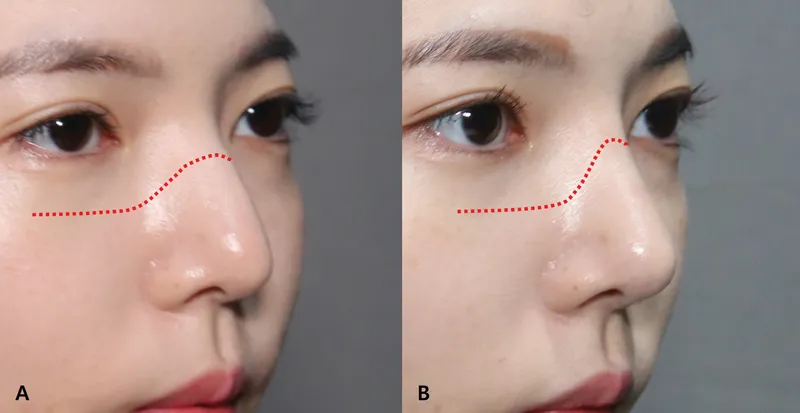
Fig. 11 “More deepening of the nasofacial groove was achieved by osteotomy, creating three-dimensional effect. Photos of a 26-year-old patient after osteotomies. (A) Preoperative view. (B) Postoperative view.”
Now look at the first row of the table under the picture. This is a peer-reviewed paper in a journal that asks its authors for a formal consent statement and gets one — and it still does not say how long after the operation (B) was taken. Not the date, not the month, not “postoperative 6 months”. Just “postoperative view”.
That is not a criticism of the paper; the figure is illustrating the shape of a groove, not claiming a settled result. It is the point of this page. If the best-documented version of this genre omits the interval, assume a marketing gallery has omitted it too — and that nobody will volunteer it unless you ask.
Beside every photograph, ask for the number of days between the operation and the picture. A clinic that photographs its own results properly will have that number on file, because standardised post-operative photography is how surgeons track their own work. Being told “a few months” is an answer about the marketing department, not about the patient.
What Korean law lets a clinic show you
Medical advertising in Korea is regulated, and the rules are more specific than most people expect.
Article 56(1) of the Medical Service Act reserves medical advertising to “the founder of a medical institution, the head of a medical institution, or medical personnel”, and defines a medical advertisement broadly: “acts of indicating information on medical services, medical institutions and medical personnel … or giving such information to consumers by means of newspapers, magazines, voices, sound, images, the Internet, printed materials, signboards and other methods.”
Article 56(2) then lists fifteen prohibited kinds. Four of them bear directly on a before-and-after picture:
| Provision | What it prohibits |
|---|---|
| 56(2)2 | Content “likely to mislead consumers about the effect of medical treatment, such as a story of one's experience in treating patients” |
| 56(2)6 | Content “that directly exposes medical treatment, such as the scene of operation” |
| 56(2)7 | Omitting important information “such as serious side effects in relation to the functions of medical personnel … or the treatment methods” |
| 56(2)8 | Advertising “that exaggerates an objective fact” |
Article 57 adds a deliberation requirement for certain media, and 56(2)11 makes it an offence to run an advertisement “not examined in accordance with Article 57 or different from the contents examined”.
Two things follow for a reader. A Korean clinic's own marketing operates inside a régime that at least names the problem. And material you find on an aggregator, a forum, a broker's site or a blog is outside it — often published by someone Article 56(1) does not permit to advertise medical services at all.
The date the “after” was taken is the whole question
The strongest evidence on this is the study we keep returning to. A three-dimensional photographic assessment of eighteen patients after primary open rhinoplasty imaged them at 7–14 days and again at 45, 90, 180 and more than 250 days. Nasal volume reached its maximum at 7 to 14 days and then fell by a mean of 2.8 ± 0.7 ml between day 7 and beyond day 250. Tip projection decreased and nasal width increased progressively between day 7 and day 90. Near-resolution came only past day 250.
Eighteen patients at one centre is a small study and the authors present it as such. Read it for its shape rather than its precision, and the shape is brutal for the genre: a photograph taken at one month is near the top of the swelling curve, and one taken at three months is still on the way down. Neither is the result. Both are commonly captioned “after”.
When each of the well-known procedures actually settles
These are the procedures foreign patients ask about most, with what the published measurements say about timing. They are findings from particular studies of particular groups, not a schedule for your face.
| Procedure | What was measured | When it settled |
|---|---|---|
| Rhinoplasty | Nasal volume, projection and width, 3D photography, n=18 | Volume peaks day 7–14; near-resolution beyond day 250 |
| Upper eyelid (double eyelid) | Suture removal across 11 studies | Non-absorbable sutures out “typically on postoperative day 5–7” |
| Upper eyelid, one protocol | Dressing, sutures, activity restrictions | Dressing off at 24 hours, sutures at 5–7 days, no eye make-up for one month |
| Genioplasty (chin) | Hard and soft tissue pogonion, n=20 | Tracked to 24 weeks; soft tissue and bone change by different amounts |
| Mandibuloplasty (jaw angle) | Mental nerve symptoms | Numbness and tingling usually recover in six months to two years |
| Breast augmentation | Photometric breast shape, n=20 | Lower pole 2.0 cm lower at 1 year, a further 0.5 cm by 10 years |
The eyelid figures come from a 2025 systematic review of eleven studies and from a published surgical protocol in Frontiers in Medicine. Stitch removal is not settling: the crease sits high and hard immediately afterwards, which is why revision is normally postponed rather than done early, and why crease height is the thing that cannot be judged in the first weeks.
The chin figures come from a 2014 study of twenty genioplasty patients measured at immediate post-op and at 3, 6, 12 and 24 weeks. At 24 weeks the change in hard-tissue pogonion was 10.5 per cent in one group and 3 per cent in the other, against soft-tissue changes of 30 and 26 per cent. Bone and the face over it do not move by the same amount, which is the part a photograph flattens. On the jaw angle, the mandibuloplasty account in PRS Global Open reports that most patients with numbness and tingling recover “without treatment in six months to two years”.
The breast figures come from a ten-year photometric study of twenty patients: the lower pole dropped 2.0 cm on the right by one year and a further 0.5 cm over the following nine, while projection gained at one year was maintained at ten. A breast photographed at six weeks is not the breast the patient will have, and neither, quite, is the one at a year.
Everything else that differs between two photographs
Even a correctly dated pair can be made to say more than it should. What changes between the two frames, besides the surgery:
- Lens and distance. A short lens close to the face enlarges the nose and narrows the jaw; stepping back with a longer lens does the reverse. The same face, two lenses, reads as a rhinoplasty.
- Lighting. Flat frontal light erases the shadow under a jaw or a nasal tip. Overhead light restores it. The figure above is a fair example of the problem in miniature: the two frames were shot against slightly different backgrounds and light, which alone changes how deep that groove reads.
- Angle and head tilt. A few degrees of chin-down reduces a jawline. Chin-up lengthens a neck.
- Expression. A relaxed mouth and a slight smile change the midface, the nasolabial folds and the eye aperture.
- Make-up, hair, eyebrows, contact lenses, weight. All of these are routinely different, and none of them is surgery.
- How many operations. A single “after” often follows two or three procedures under one anaesthetic. Ask which.
- Whose patient it is. A clinic's gallery may show the collective work of several surgeons. Ask whether the pictured patient was operated on by the surgeon you are being quoted for.
None of this requires anyone to be dishonest. A clinic can photograph in good faith and still produce a pair that overstates, simply by not standardising. Standardised photography — fixed distance, fixed lens, fixed lighting, fixed expression, fixed interval — is how a surgeon audits their own results, and asking whether it is done tells you something about the practice regardless of the answer.
What we will and will not publish here
One figure, reproduced under the conditions set out beside it, is the whole of our before-and-after library, and it is likely to stay that way. The test any image has to pass before it appears on this site:
- A licence that permits reproduction. Creative Commons Attribution, or equivalent, stated by the publisher.
- Consent that covers publication, not just treatment. Consenting to an operation is not consenting to appear on a website. A paper that says consent was waived, or says only that patients consented to surgery, does not qualify — we rejected two otherwise ideal Korean rhinoplasty papers on exactly this.
- A stated adult. If the source does not give an age and the subject could be a minor, it is out, whatever the licence says.
- Attribution printed beside the image. Authors, journal, DOI, licence and the consent statement, verbatim — as above.
That rules out every clinic gallery, every aggregator and every forum repost, for a reason worth stating plainly: the consent a clinic holds is consent for that clinic, and it does not travel to us. Article 56(1) is the second reason — it reserves medical advertising to medical personnel and institutions, and this publication is neither, so we stay well clear of anything that reads as surgical result marketing. Nothing here is AI-generated, and no image on this site is presented as a patient unless it is one, with the paperwork shown.
Ask the surgeon, in the consultation, to show you their own standardised series for your procedure, with the interval written beside each image, and to include a case that needed revision. Ask what proportion of their cases they photograph. The answer to that second question is more informative than any gallery.
What to do with this
Treat a before-and-after pair as a claim, not as evidence, and ask for the interval before you ask for anything else. Then check the things that are actually checkable: the institution, the surgeon's specialty certificate, the itemised quotation against HIRA's non-covered price disclosure, and the written consent that has to name the operating surgeon. If a result is misrepresented badly enough to become a dispute, the Korea Medical Dispute Mediation and Arbitration Agency is the body that handles it.
How plastic surgery in Korea works, step by step sets out where in the sequence each of those checks belongs. Recovery after plastic surgery in Korea has the measured curves in full. How to choose a clinic in Korea covers the registers. The questions above are on the planning checklist.
Common questions
- Are Korean plastic surgery before and after photos real?
- Some are photographs of real patients and some are not, and from outside the clinic you cannot tell which. The more useful question is when the "after" was taken. A three-dimensional study of primary rhinoplasty found swelling near-resolved only beyond day 250, so an "after" photographed at one month or three months shows an intermediate state, whether or not the photograph is honest.
- How long after surgery is an "after" photo meaningful?
- It depends on the procedure and there is no single answer. The published measurements run from roughly six months for genioplasty soft tissue, to beyond 250 days for rhinoplasty swelling, to ten years of continuing descent in the lower pole after breast augmentation. Ask for the number of days after surgery beside every photograph you are shown.
- What should I ask to see instead of before and after photos?
- Ask for the interval. Ask whether the photographs are of the surgeon’s own patients or the clinic’s collective work, whether they were taken at the same distance, lens, lighting and expression, and how many operations the pictured patient had at once. A clinic that photographs its results properly will have the dates.
- Does this site publish before and after photographs?
- Only one, and only because every condition could be checked: it is a figure from a peer-reviewed paper published under a Creative Commons Attribution licence, the patient gave written consent to publication of their images, and the patient is a stated adult. We do not reproduce clinic marketing galleries, because the consent a clinic holds does not extend to us and we could not date the images.
Sources
- Nasal Osteotomies Revisited in Asians: Surface Aesthetics, Anatomical and Technical Considerations. Archives of Plastic Surgery. Read 22 Sept 2026.
- Medical Service Act (English translation, Act No. 19818). Korean Law Information Center. Read 22 Sept 2026.
- Discovering the True Resolution of Postoperative Swelling After Rhinoplasty Using 3-dimensional Photographic Assessment. Plastic and Reconstructive Surgery – Global Open. Read 21 Sept 2026.
- The small incisions combined with interrupted buried suture blepharoplasty: flexible-rigid fixation. Frontiers in Medicine. Read 21 Sept 2026.
- Absorbable versus non-absorbable sutures in upper eyelid blepharoplasty: a systematic review of clinical outcomes and follow-up burden. BMC Ophthalmology. Read 21 Sept 2026.
- Profile changes after conventional and chin shield genioplasty. Journal of Oral Biology and Craniofacial Research. Read 22 Sept 2026.
- Facial Contouring Surgery—Mandibuloplasty: Genioplasty and Mandible Angle Correction. Plastic and Reconstructive Surgery – Global Open. Read 21 Sept 2026.
- Photometric Evaluation of Long-term Changes in Breast Shape after Breast Augmentation and Vertical Mammaplasty. Plastic and Reconstructive Surgery – Global Open. Read 22 Sept 2026.
- Non-covered treatment cost information (비급여 진료비용 정보). Health Insurance Review and Assessment Service. Read 21 Sept 2026.
- Korea Medical Dispute Mediation and Arbitration Agency. K-MEDI. Read 21 Sept 2026.