01
Seoul Serene Recovery Updated 22 Sept 2026
Recovery
Recovery after plastic surgery in Korea, week by week
Discharge and recovery are different events, and the gap between them is longer than most itineraries allow. What the measured timelines show, and what you are on your own for.
Being discharged and being recovered are different events, and the gap between them is longer than most itineraries allow. Discharge means a clinic is satisfied you are stable enough to leave the building. Recovery means the swelling has fallen far enough that what you see in the mirror is the result rather than the operation. The measured timelines put the second point months after the first.
This page is about that gap: what the measurements show, what Korean clinics include, and what you are on your own for.
The recovery system, stage by stage
Recovery has a structure, and it is mostly a structure of custody: who is responsible for you, and at which moment that responsibility is handed to someone else or to nobody. The measurements behind the dates are set out further down this page. This is the shape they make.
-
Hours 0 to 6 · recovery room
You are still the clinic's problem
Discharge is a clinical judgement that you are stable enough to leave the building. It is not a statement about the result, and it is not a statement about whether you can look after yourself in a hotel room.
Held by: the clinic.
-
Days 0 to 3
Bruising and swelling climb
The blepharoplasty review by Oestreicher and Mehta describes bruising as expected in all patients and ice-water compresses applied continuously for the first three days. Whatever your procedure, these are the days to have somebody with you, a way to reach the clinic out of hours, and nothing in the diary.
Held by: you, in a hotel, in a city you cannot read.
-
Days 5 to 7
Sutures come out — the appointment that fixes your flight
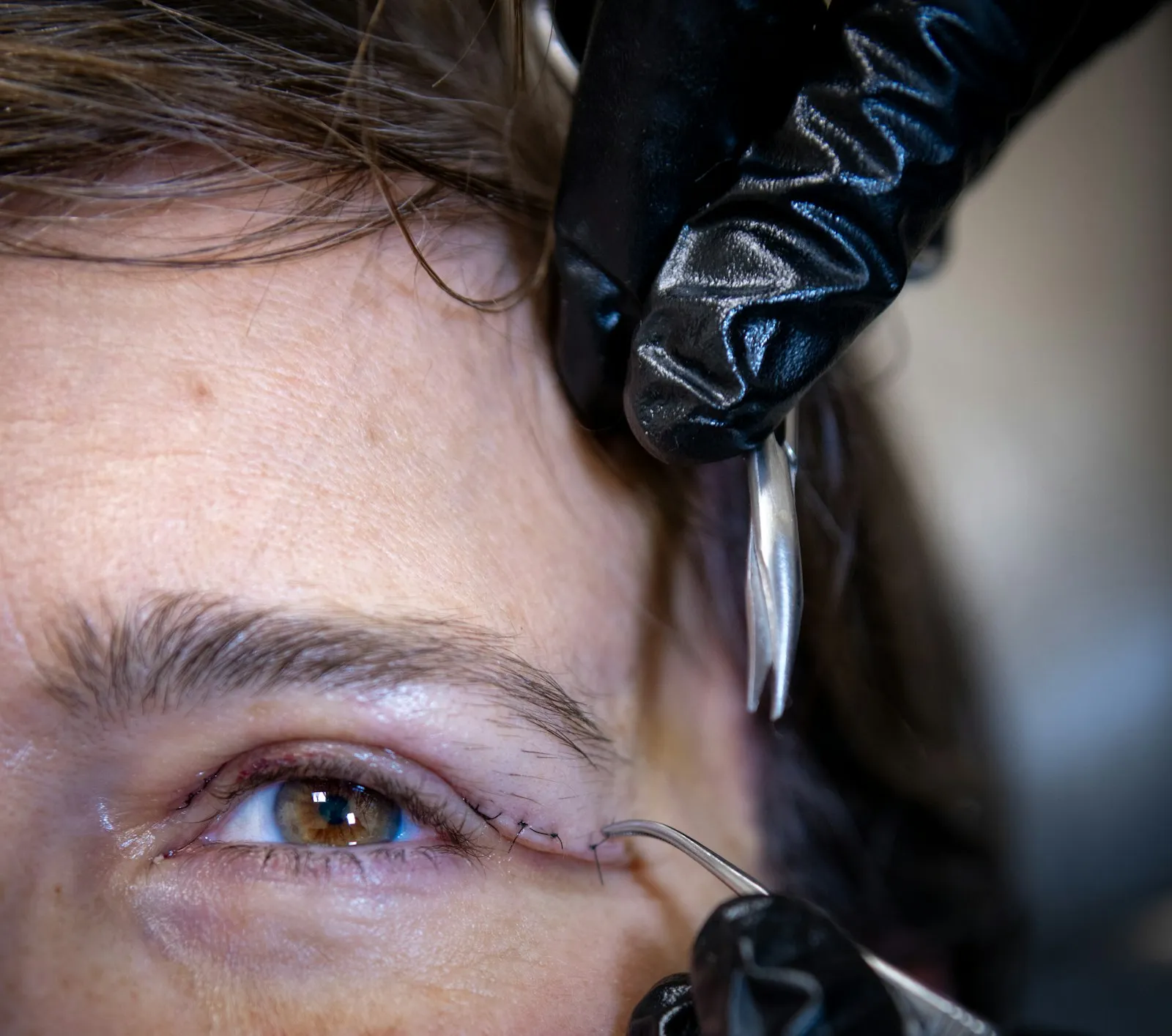
The 2025 systematic review of upper eyelid blepharoplasty records non-absorbable sutures being removed "typically on postoperative day 5–7"; rhinoplasty protocols commonly take the splint and stitches at day seven. This is the last thing that has to happen in Korea, so it sets the earliest date you can leave, not the other way round.
Held by: the clinic, for the last time in person.
-
Days 7 to 14
The worst it will look
Nasal volume peaks seven to fourteen days after open rhinoplasty. This is the fortnight in which people photograph themselves, post the photograph, write the review and start the argument — about a result that does not exist yet.
Held by: nobody. This is the gap the rest of the page is about.
-
Before the flight
The handover
Whether you are fit to fly is a decision for your operating surgeon, not for a website and not for an airline's general guidance. Leave with the operative record, the discharge summary, the itemised receipt, the surgeon's name in Korean characters, the maker and model of anything implanted, every prescription, the after-hours number and the name of the hospital the clinic would send you to.
Held by: transferred from the clinic to you, in one appointment.
-
Days 45 to 90
Review by correspondence
Projection falls and width increases progressively between day seven and day ninety. You will be assessing this from another continent, so the mechanism has to be agreed in advance: who looks at the photographs, how quickly they answer, and in which language.
Held by: whoever you got to agree in writing. Otherwise nobody.
-
Day 180 to beyond day 250
The result finally arrives
Near-resolution of rhinoplasty swelling came only past day 250 in the three-dimensional study below, with a mean 2.8 ± 0.7 ml of volume lost since day seven. This is the first point at which what you see is the operation's outcome rather than its aftermath — and it falls most of a year after the consultation that sold it.
Held by: you, and a doctor at home who did not operate.
-
At any point
The things that are not recovery
Asymmetrical pain, decreased vision or a protruding eye after eyelid surgery is an emergency, not a stage. Orbital haemorrhage is unlikely to be treatable beyond one to six hours of total or near-total vision loss. 119 is the ambulance number; 1339 is the KDCA line, staffed around the clock with interpreters. Ask your surgeon which signs they want to be telephoned about, and write the answer down.
Held by: an emergency department, immediately.
-
If it went wrong
The dispute route
K-MEDI mediates medical disputes, is open to foreign nationals and aims to conclude in around ninety days. Article 21(1) of the Medical Service Act gives you the right to inspect or copy your records, and it cannot be refused without good cause. Both work far better if you collected the file at stage five.
Held by: K-MEDI, on 1670-2545.
Discharge is a clinical decision, recovery is a measurement
The useful thing about recovery, as against almost everything else in cosmetic surgery, is that some of it has been measured rather than asserted.
A study published in Plastic and Reconstructive Surgery – Global Open in 2019 used three-dimensional photography to track eighteen patients after primary open rhinoplasty, imaging them at seven to fourteen days and again at forty-five, ninety, one hundred and eighty and more than two hundred and fifty days. Maximum nasal volume occurred seven to fourteen days after the operation, and the mean volume lost between that point and day 250-plus was 2.8 ± 0.7 ml. Projection fell and width increased steadily from day seven to day ninety. Near-resolution came only beyond day 250.
Eighteen patients at one centre is a small study, and the authors present it as such. Two things still follow. The swelling curve does not begin to go your way until after the week most foreign patients spend in Korea. And anyone who gives you a date is guessing.
The first photograph you take of yourself is the worst one
Take one in the first fortnight — hotel bathroom, ceiling light — and you are photographing the top of the curve. The face in the picture is the operation, not the result.
It is worth knowing this in advance, because the fortnight after surgery is when people make decisions they cannot unmake: sending the photograph to a friend, posting it, writing a review, or arguing with the clinic about a result that does not exist yet. The same study found that oedema was consistently greater in the upper two-thirds of the nose than at the tip, and that its distribution shifted over time — so the shape you see early is not a smaller version of the shape you will end up with. It is a different shape.
| Period | What the measurements and reviews describe | Where the range comes from |
|---|---|---|
| Days 0–3 | Bruising is expected in all patients; the review describes ice-water compresses applied continuously for three days | Oestreicher & Mehta, Plastic Surgery International, 2012 |
| Days 5–7 | Non-absorbable sutures in the upper eyelid are typically removed | Safaripour et al., BMC Ophthalmology, 2025 |
| Days 7–14 | After open rhinoplasty, nasal volume is at its maximum | Schreiber et al., PRS Global Open, 2019 (n = 18) |
| Days 7–90 | Nasal projection decreases and width increases progressively | Same study |
| Days 90–250 | Further measurements at 180 days and beyond 250; total volume lost since day 7 was 2.8 ± 0.7 ml | Same study |
| Beyond day 250 | Near-resolution of rhinoplasty swelling | Same study |
| At any point | Asymmetrical pain, decreased vision or a protruding eye after eyelid surgery is described as an emergency, not as recovery | Oestreicher & Mehta, 2012 |
These are typical ranges from published studies of particular operations in particular populations. They are not a rule, a schedule or a promise about your face. A different procedure, a revision, or several operations under one anaesthetic will follow a curve nobody has published.
Stitches come out before you start to look better
A 2025 systematic review in BMC Ophthalmology covering eleven studies of upper eyelid blepharoplasty records that non-absorbable sutures are removed “typically on postoperative day 5–7”. It also found that absorbable and non-absorbable sutures produced equivalent scar quality and complication rates.
The interesting part of that review is what it could not find. Absorbable sutures are supposed to cut the follow-up burden and the discomfort. No included study measured either — not visit numbers, not resource use, not discomfort. The advantage quoted at consultations has not been quantified.
The removal date is a logistics problem, and it is yours. If removal falls on day six, your flight cannot be on day five. Leave earlier and you are asking a doctor at home to take out another surgeon’s stitches — a favour some will do and some will not.
Aftercare is a line on the quotation, not a courtesy
We could not find any published survey of what Korean clinics include as standard aftercare, and we are not going to invent one. What can be established is where to look.
Cosmetic surgery in Korea is a non-covered treatment, outside national health insurance, which means the Health Insurance Review and Assessment Service publishes disclosed prices for it. HIRA’s non-covered cost disclosure is searchable by institution across roughly six hundred designated items. It lags — a clinic can change a price before the database catches up — but it is the only public price reference that is not written by a seller.
Everything else comes off an itemised quotation. The aftercare lines, each with a figure beside it:
- How many review visits are included, and over what period.
- What a review visit covers, and what is billed separately.
- Dressings, medication and any injections given during recovery.
- Suture removal, if it is billed at all.
- The revision policy: free, discounted or full price, and for how long.
A quotation with a single number and no breakdown is not a quotation. The cost guide sets out the full list of lines to ask for.
Before you are discharged, ask for four things
The clinic's after-hours telephone number and who answers it. The name of the hospital they would send you to if you needed one. Your operative record and discharge summary. The date your sutures are due out. Records are far easier to obtain while you are still in the building than from another continent six weeks later.
Recovering in a city you cannot read
Seoul is an easy city to be well in and a harder one to be unwell in at two in the morning.
119 is the emergency number for an ambulance.
1339 is the call centre of the Korea Disease Control and Prevention Agency, toll-free inside Korea, reachable from abroad on +82-2-2633-1339 and staffed 24/7/365. The KDCA’s own English page frames it around infectious disease and travel health. The Korea Times reported in March 2026 that the line also gives medical consultation and guidance on handling emergencies, with three-way interpreter calling for non-Korean speakers, and can be reached through KakaoTalk. It is a health information line. It is not a cosmetic surgery advice line.
1330 is the Korea Tourism Organization’s line, 07:00 to midnight, in eight languages including English, Japanese, Chinese, Russian and Vietnamese. 1345 is the immigration contact centre, in twenty languages, 09:00 to 18:00, with English, Chinese and Korean until 22:00.
On pharmacies: the same report describes late-night pharmacies typically opening from around 22:00 into the early hours, and notes that 24-hour convenience stores carry a small range of over-the-counter medicines. Neither is a plan. If you are taking antibiotics or analgesics prescribed by your clinic, the time to ask what to do if you run out, react badly or lose the box is at discharge, not at midnight.
The follow-up plan matters most once the clinic is eight time zones away
The strongest published argument for taking follow-up seriously comes from the complications literature. A systematic review in Annals of Plastic Surgery in December 2023 pulled together forty-four studies describing 589 patients who presented with complications after cosmetic procedures performed abroad. Infection was the most common, followed by wound dehiscence, seroma or haematoma, and tissue necrosis. Ninety-eight per cent of the infectious organisms were bacterial, and 81 per cent of those came from the Mycobacterium genus.
Read that correctly. It counts people who turned up with a problem; it is not a rate. The denominator — how many had surgery abroad without complication — is not in the paper. What it establishes is the shape of the problem: complications abroad arrive after the patient has left, and are handled by people who did not perform the operation and do not hold the records.
That is the argument for settling three things before you fly home:
- Who reviews you, and when. If the clinic offers remote review, get the mechanism in writing — who looks at the photographs, how quickly they reply, and in which language.
- What you are carrying. Operative record, discharge summary, itemised receipt, the operating surgeon’s full Korean name in Korean characters, the name and maker of anything implanted, and every prescription. A doctor at home cannot help you efficiently without these.
- Who you complain to. The Korea Medical Dispute Mediation and Arbitration Agency mediates medical disputes, is open to foreign nationals, aims to conclude cases in around ninety days, and a mediation agreement has the effect of a court settlement. The free consultation line is 1670-2545, weekdays 09:00 to 18:00. Institutions registered to treat foreign patients are required to carry medical liability insurance, and the registers are public through Medical Korea.
On what counts as wrong rather than slow: the review of blepharoplasty complications by Oestreicher and Mehta in Plastic Surgery International describes orbital haemorrhage as the emergency to recognise, presenting with asymmetrical pain, decreased vision or proptosis, and notes that treatment beyond one to six hours of total or near-total vision loss is unlikely to be effective. The same paper says patients should be told what to look for and given “an effective emergency contact arrangement”. Ask your surgeon which signs they want to be telephoned about, at what hour, and write the answer down. No website is in a position to tell you what is wrong with your own face, and this one is not trying to.
Where to go next
- How long to stay in Korea for surgery, which is the decision this page is really about.
- Is plastic surgery in Korea safe? What the rules actually say, for the records and registration side.
- Rhinoplasty in Korea and double eyelid surgery in Korea for the procedure-specific detail.
The questions above, condensed into something you can take into a consultation and a discharge, are on the planning checklist.
Sources
- Discovering the True Resolution of Postoperative Swelling After Rhinoplasty Using 3-dimensional Photographic Assessment. Plastic and Reconstructive Surgery – Global Open. Read 21 Sept 2026.
- Absorbable versus non-absorbable sutures in upper eyelid blepharoplasty: a systematic review of clinical outcomes and follow-up burden. BMC Ophthalmology. Read 21 Sept 2026.
- Complications of Blepharoplasty: Prevention and Management. Plastic Surgery International. Read 21 Sept 2026.
- Complications of Medical Tourism in Aesthetic Surgery: A Systematic Review. Annals of Plastic Surgery. Read 21 Sept 2026.
- Sick in Korea after hours? Here's what visitors need to know. The Korea Times. Read 21 Sept 2026.
- KDCA Call Center (1339). Korea Disease Control and Prevention Agency. Read 21 Sept 2026.
- Disclosure of non-covered treatment costs. Health Insurance Review and Assessment Service. Read 21 Sept 2026.
- Korea Medical Dispute Mediation and Arbitration Agency. K-MEDI. Read 21 Sept 2026.
- Medical Service Act (English translation, Act No. 19818). Korean Law Information Center. Read 22 Sept 2026.
- Registration system for hospitals and facilitators treating foreign patients. Medical Korea, Korea Health Industry Development Institute. Read 21 Sept 2026.
The Korea surgery planning checklist
One page: the licences to check, the questions to ask in a consultation, what to put in writing, and how long to keep the week free afterwards. Free, and we send it once.
The checklist goes out by email. Until the list opens, write to hello@seoulseren.com and we will send it back by hand.
Photograph by SUN STUDIO CREATIVE / Unsplash