
01
Seoul Serene Procedures Updated 21 Sept 2026
Procedures
Double eyelid surgery in Korea: methods, cost and recovery
Three different operations are sold under one name, and the package price usually contains more than one of them. What separates them is permanence, what they cost to undo, and whether they touch the muscle that lifts the eyelid.
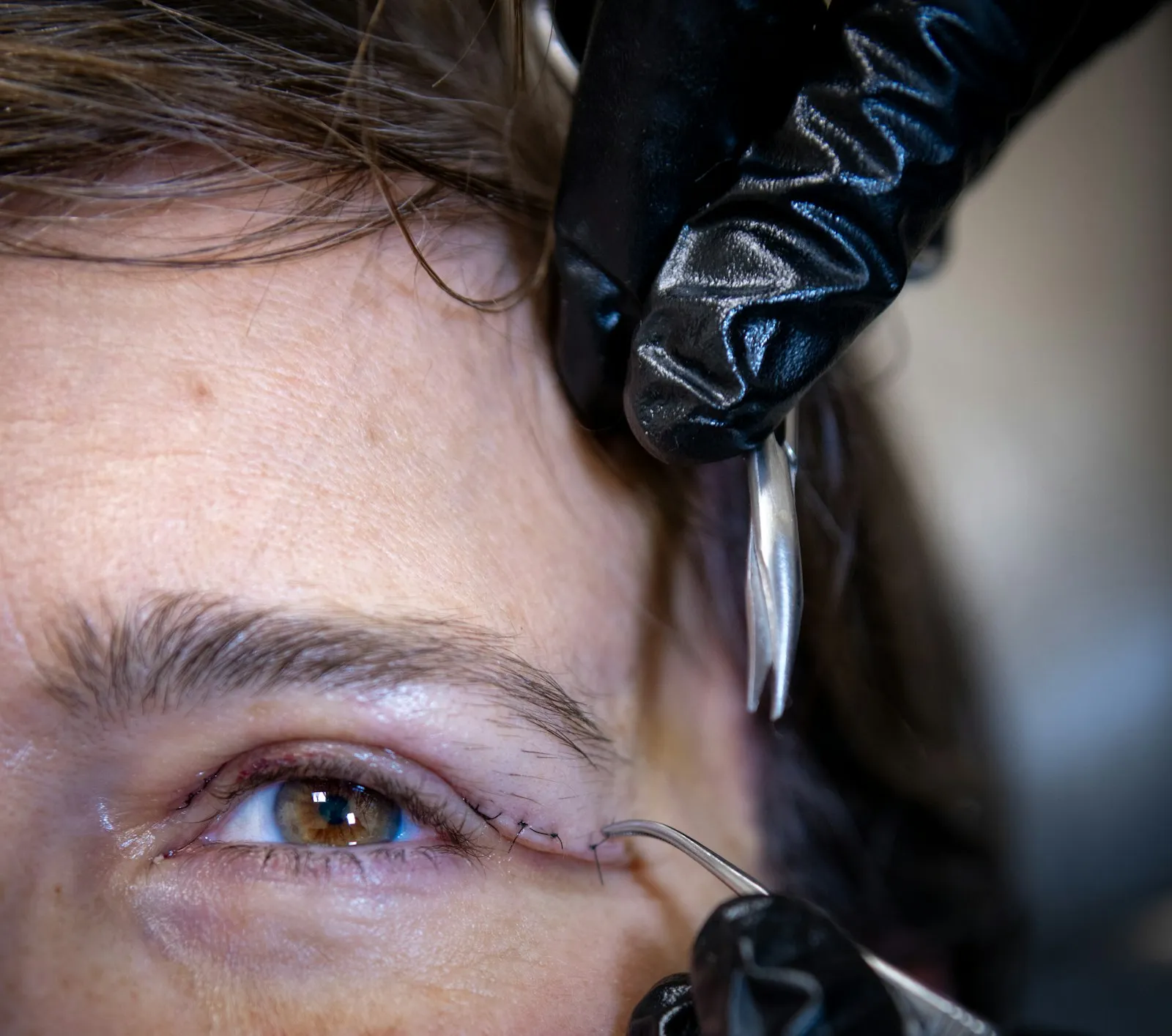
Double eyelid surgery is a family of at least three different operations, and the name on the price list rarely tells you which one you are having. The choice between them decides how permanent the crease is, how visible the evidence is, and how difficult it will be to change your mind. Two further procedures — ptosis correction and epicanthoplasty — are routinely folded into the same quoted package while being surgery on entirely different structures.
Three methods, and only one of them is easy to undo
The literature divides upper-eyelid crease surgery into three types: non-incisional, partial-incisional and incisional. A 2024 review in Frontiers in Medicine sets out what separates them, and the distinction is not simply the length of the cut.
Non-incisional methods, usually called buried suture, pass thread through the eyelid to bind skin to the deeper tissue until adhesion forms. No skin is removed. The review notes that the buried-thread method has “relatively brief efficacy” and suits a narrow group of eyelids — thin skin, little or no redundant skin, little orbicularis muscle bulk, little orbital fat. If your eyelid is outside that description, the method is being asked to do something it was not designed for.
Incisional methods cut along the intended crease, remove tissue, and fix the skin to the tarsal plate or to the levator aponeurosis. The review draws a useful line inside this category. Fixation directly between skin and tarsus, which it calls rigid fixation, produces a stable and long-lasting crease with a stiff curve and heavier surgical marks. Fixation that links the levator aponeurosis to the skin, called flexible fixation, gives a more natural curve but does not last as long. Partial incision sits between the two.
Durability is the axis most consultations are sold on, and the evidence is more ambiguous than the sales pitch. The same paper reports 333 patients split between a small-incision group of 244 and a full-incision group of 89. At both six months and five years, satisfaction was statistically higher in the small-incision group, and the overall complication rate was significantly lower — but permanence showed no statistically significant difference between them.
Where buried suture does differ is in how it fails, and what failure costs. A study of 513 consecutive non-incisional patients operated on over a single year, published in Archives of Plastic Surgery, measured crease loss defined as needing revision because the crease had faded or disappeared. Continuous fixation retained creases markedly better than interrupted fixation, and puffy eyelids — present in 54.5 per cent of the cohort — interacted with the fixation method. Surgeon experience was measured separately, stratified at 100 prior cases.
Threads can also cause trouble of their own. One series examined 210 upper eyelids in 116 consecutive patients who came for suture removal surgery after buried-suture blepharoplasty performed at other clinics. Only 12 of them, 10.3 per cent, could be treated by removing the sutures alone; the remaining 104, 89.7 per cent, needed a secondary double-eyelid operation at the same time. “Easily reversible” describes the intent of the technique better than it describes the repair.
Ptosis correction and epicanthoplasty are separate operations sold as one
Ptosis and pseudoptosis are not the same condition. A review in Seminars in Plastic Surgery draws the distinction precisely: ptosis is weak function of the levator aponeurosis–Müller muscle complex, the mechanism that lifts the lid, while pseudoptosis is the eye being obstructed by drooping skin despite normal muscle function. Most people who want a double eyelid have the second, not the first. Creating a fold alone can improve pseudoptosis. Exposing more cornea than that generally requires operating on the levator–Müller complex itself — and the review is blunt that many complications arise from that surgery, and that they raise the reoperation rate.
Epicanthoplasty is different again. It alters the fold of skin covering the inner corner of the eye, and its characteristic problem is not the shape but the mark left behind. A 2025 review in the Journal of Cosmetic Dermatology devoted to minimising post-epicanthoplasty scarring notes that surgeons have long been concerned about hypertrophic scarring after the procedure, and that the population most likely to seek it is genetically more susceptible to hypertrophic scars.
A separate seven-year analysis of 138 blepharoplasty complaints bears this out from the patient’s side. Asymmetry was the most frequent cause of dissatisfaction after both primary and revision double-eyelid surgery, with asymmetric crease height accounting for most of that category. Compared with a primary double-eyelid operation, epicanthoplasty was significantly more likely to generate complaints of noticeable scarring.
Ask for the package to be unbundled
Request the quotation line by line, with each operation named separately: crease formation, ptosis correction, epicanthoplasty, lateral canthoplasty, fat removal. Ask which of them the surgeon considers necessary and which were added to the package, and ask what each one costs on its own. A package that cannot be broken apart on paper cannot be consented to properly.
Aegyo sal is a different thing entirely
Aegyo sal, the small roll of fullness directly beneath the lower lash line, is not part of double eyelid surgery and is usually not surgery at all. It is most often created with hyaluronic acid filler or with fat grafting, in the lower eyelid rather than the upper. Surgical versions exist: one retrospective series of 68 patients used capsulopalpebral fascia plication with a silicone prosthesis, reporting a mean operative time of 46.3 minutes and mean pretarsal protrusion increasing from 1.2 to 2.9 millimetres.
The lower eyelid is unforgiving territory for injectables. A paper in Aesthetic Surgery Journal Open Forum describes the region as a source of unsatisfactory outcomes and makes a point worth holding onto: patients are often told that an undesirable filler result can simply be dissolved with hyaluronidase, but the author’s experience of 70 consecutive referred cases is that this is not always successful. If aegyo sal appears on your quotation, treat it as a decision of its own, with its own consent and its own timeline, rather than a finishing touch on an eyelid operation.
Stitches come out in a week, the crease settles over months
Timelines vary by surgeon, so treat any single published schedule as one example rather than the standard. In the Frontiers in Medicine protocol, the pressure dressing came off after 24 hours, the incision was kept dry until sutures were removed 5 to 7 days after surgery, and patients were told to open their eyes frequently and to avoid rubbing them or wearing eye make-up for one month.
Stitch removal is not the end of the swelling. The crease sits high and looks harder immediately after surgery than it will later, and the settling continues for months — which is the reason revision is normally postponed rather than performed early. It is also why the complaint data above matters: asymmetric crease height is the commonest grievance, and height is exactly the thing that is impossible to judge in the first weeks. If you are travelling, plan for the stitches and the first review to happen in Korea, and for the assessment of the result to happen long after you have flown home.
What the package price leaves out
Cosmetic surgery is non-covered care in Korea, outside the insurance schedule, so clinics set their own prices. The Health Insurance Review and Assessment Service publishes a database of declared non-covered costs searchable by institution, which is the only public reference point — with the caveat that it lags behind price changes.
Eye surgery quotations are particularly prone to arriving as one number covering several operations. Ask specifically whether the figure includes the anaesthetic and who administers it, the pre-operative assessment, every follow-up visit, suture removal, medication, and what a revision would cost and on what terms it would be free. Ask what happens to the price if the surgeon decides during the consultation that ptosis correction is needed. Korea treated 1,170,467 foreign patients in 2024, according to Ministry of Health and Welfare figures published in April 2025, and plastic surgery accounted for 11.4 per cent of them. Volume does not make the paperwork clearer.
Before you book
Get the quotation unbundled, find out which of the three methods is being proposed and why that one suits your eyelid, and establish who performs each part of the operation. Our guide to what plastic surgery costs in Korea explains how non-covered pricing works, and how to choose a clinic in Korea covers verifying that the surgeon is a board-certified specialist. The checklist turns the questions above into something you can take with you.
Sources
- The small incisions combined with interrupted buried suture blepharoplasty: flexible-rigid fixation. Frontiers in Medicine. Read 21 Sept 2026.
- The HIROSHIMA Study: A High-Volume, Institutional, Retrospective, Observational Study of Hidden Non-Incisional Suture Double Eyelid Surgery for Multivariate Analysis of Crease Loss. Archives of Plastic Surgery. Read 21 Sept 2026.
- Treatment of Suture-related Complications of Buried-suture Double-eyelid Blepharoplasty in Asians. Plastic and Reconstructive Surgery – Global Open. Read 21 Sept 2026.
- A 7-year analysis of complaints related to Asian blepharoplasty. Journal of Cosmetic Dermatology. Read 21 Sept 2026.
- Minimizing Postoperative Scars in Epicanthoplasty: A Concise Review. Journal of Cosmetic Dermatology. Read 21 Sept 2026.
- Subclinical Ptosis Correction: Incision, Partial Incision, and Nonincision: The Formation of the Double Fold. Seminars in Plastic Surgery. Read 21 Sept 2026.
- The Treatment of Cosmetic Lower Eyelid Adverse Events After Injection of Hyaluronic Acid Gel Fillers. Aesthetic Surgery Journal Open Forum. Read 21 Sept 2026.
- Clinical outcomes of pretarsal fullness formation by capsulopalpebral fascia plication with silicone prosthesis implantation and pretarsal fullness surgery. Medicine. Read 21 Sept 2026.
- Non-covered treatment cost information (비급여 진료비용 정보). Health Insurance Review and Assessment Service. Read 21 Sept 2026.
- Medical tourism in 2024 attracts record 1.17M int'l patients. Korea.net. Read 21 Sept 2026.
The Korea surgery planning checklist
One page: the licences to check, the questions to ask in a consultation, what to put in writing, and how long to keep the week free afterwards. Free, and we send it once.
The checklist goes out by email. Until the list opens, write to [email protected] and we will send it back by hand.
Photograph by SUN STUDIO CREATIVE / Unsplash