01
Seoul Serene Procedures Updated 21 Sept 2026
Procedures
Rhinoplasty in Korea: what it costs and what to ask first
Korean clinics set their own cosmetic prices and rarely publish them in full. What decides both the cost and the risk is what goes inside the nose, and whether this is a first operation or a second.

No one can tell you in advance what a rhinoplasty in Korea will cost, because cosmetic surgery sits outside the national health insurance system and every clinic sets its own price. What you can do is look up what a clinic has formally declared, and then refuse to accept a quotation that arrives as a single number. The two decisions that drive both the price and the risk are technical: what goes inside the nose, and whether this is a first operation or a second.
A quoted price is a headline, not a bill
Cosmetic procedures are non-covered care in Korea. That means no insurance schedule sets the fee, and no regulator approves it. The one public record is the Health Insurance Review and Assessment Service, which runs a disclosure of non-covered treatment costs searchable by institution across roughly 600 designated items. It is worth opening before a consultation, with one caveat: there is a lag between a clinic changing a price and the database reflecting it, so treat what you find as a declared figure rather than today’s figure.
The gap between the message you receive and the invoice you sign is usually made of things nobody mentioned. Ask for each of these as a separate line: the surgeon’s fee, the anaesthesia and who administers it, the facility or operating-theatre charge, the implant or graft material by name, pre-operative imaging and blood work, the nights of observation if any, medication, every follow-up visit, and the price of a revision if one is needed.
Anaesthesia deserves its own line for reasons beyond cost. In February 2026 the Korea Herald reported a National Forensic Service analysis of autopsy records finding 50 deaths linked to cosmetic surgery between 2016 and 2024. Nearly half, 23, were attributed to anaesthesia. Twenty-two of those anaesthesia-related deaths occurred at clinic-level institutions, defined as having fewer than 30 beds, against one at a university hospital — and a specialist anaesthesiologist was present in the operating room in only six of the cases. Whether your quotation includes a separately qualified anaesthetist, or assumes the operating surgeon will manage sedation, is a material question.
What goes inside the nose is the choice that lasts
Most rhinoplasty in Korea involves augmentation, and augmentation requires material. It comes from one of two families: manufactured implants, or the patient’s own cartilage. Each commits you to something different for the rest of your life.
| Material | What it is | What the literature reports |
|---|---|---|
| Silicone | A preformed implant, the most widely used | Pooled revision rate 7.64% across the studies reviewed |
| ePTFE (Gore-Tex) | A porous polymer the tissue partly grows into | Pooled revision rate 4.91%; harder to remove cleanly once integrated |
| Porous polyethylene (Medpor) | A rigid porous implant | Pooled revision rate 6.61% |
| Septal cartilage | Taken from inside your own nose | Preferred donor site, but limited in quantity |
| Ear (auricular) cartilage | Taken from the bowl of the ear | Naturally curved; less volume than rib |
| Rib (costal) cartilage | Taken through a chest incision | Strength and volume; adds a second surgical site and a scar |
The implant figures come from a 2022 systematic review and meta-analysis of 27 observational studies covering 3,803 cases. It pooled complications at 2.75 per cent, with infection at 1.91 per cent, extrusion at 0.78 per cent and deviation at 0.72 per cent, and put the overall revision rate at 6.40 per cent — that last figure drawn from the smaller subset of 451 patients whose studies reported revision surgery at all. The confidence intervals around each material overlap heavily. These are not league tables, and no serious reading of them produces a single best implant.
What the numbers do not show is the shape of failure, which differs by material. A Korean series published in the Yonsei Medical Journal reviewed 581 revision rhinoplasty cases over ten years — silicone in 376, Gore-Tex in 183, porous polyethylene in 22. Among the silicone cases the recorded problems were capsular contracture in 131, implant deviation in 113, skin problems in 75, infection in 38 and protrusion in 19. That series counted only people who already had a complication, so it says nothing about how often these things happen. It says a great deal about what they are when they do.
Cartilage avoids the foreign-body problem and introduces its own. A 2026 meta-analysis of 25 studies and 2,322 patients receiving costal cartilage found infection in 1 to 2 per cent and warping in 1 to 3 per cent across graft types, with revision rates varying from 1 per cent for fresh-frozen cartilage up to 7 per cent for autologous and irradiated homologous cartilage — a spread the authors attribute partly to high heterogeneity between studies rather than to the material alone. Rib cartilage is chosen for strength and quantity. It also means a chest incision, a second healing site and a permanent scar there, which is the part that rarely appears in a price list.
Revision rhinoplasty is a different operation, priced as one
A revision is not the first operation performed again. The same Yonsei review notes the reason plainly: the material used the first time creates the problem the second surgeon inherits, whether that is a contracted capsule, a shifted implant or thinned skin over the dorsum.
The supply of cartilage is the other complication. The costal cartilage meta-analysis observes that septal cartilage is regarded as the ideal donor source, but that in revision work the septum may already have been harvested or compromised by the original procedure, and substantial graft volume is needed. That is how a revision becomes a rib operation, with a chest incision, a longer procedure and a different anaesthetic requirement — none of which follow from a primary rhinoplasty price.
If you were operated on elsewhere
Bring the operative record from your first surgery, not a description of it. A surgeon needs to know which material was used, where it sits and what was removed. If you cannot obtain that record, say so at the consultation rather than at the pre-operative check, because it changes what the second operation has to be.
The splint comes off in a week, the shape takes most of a year
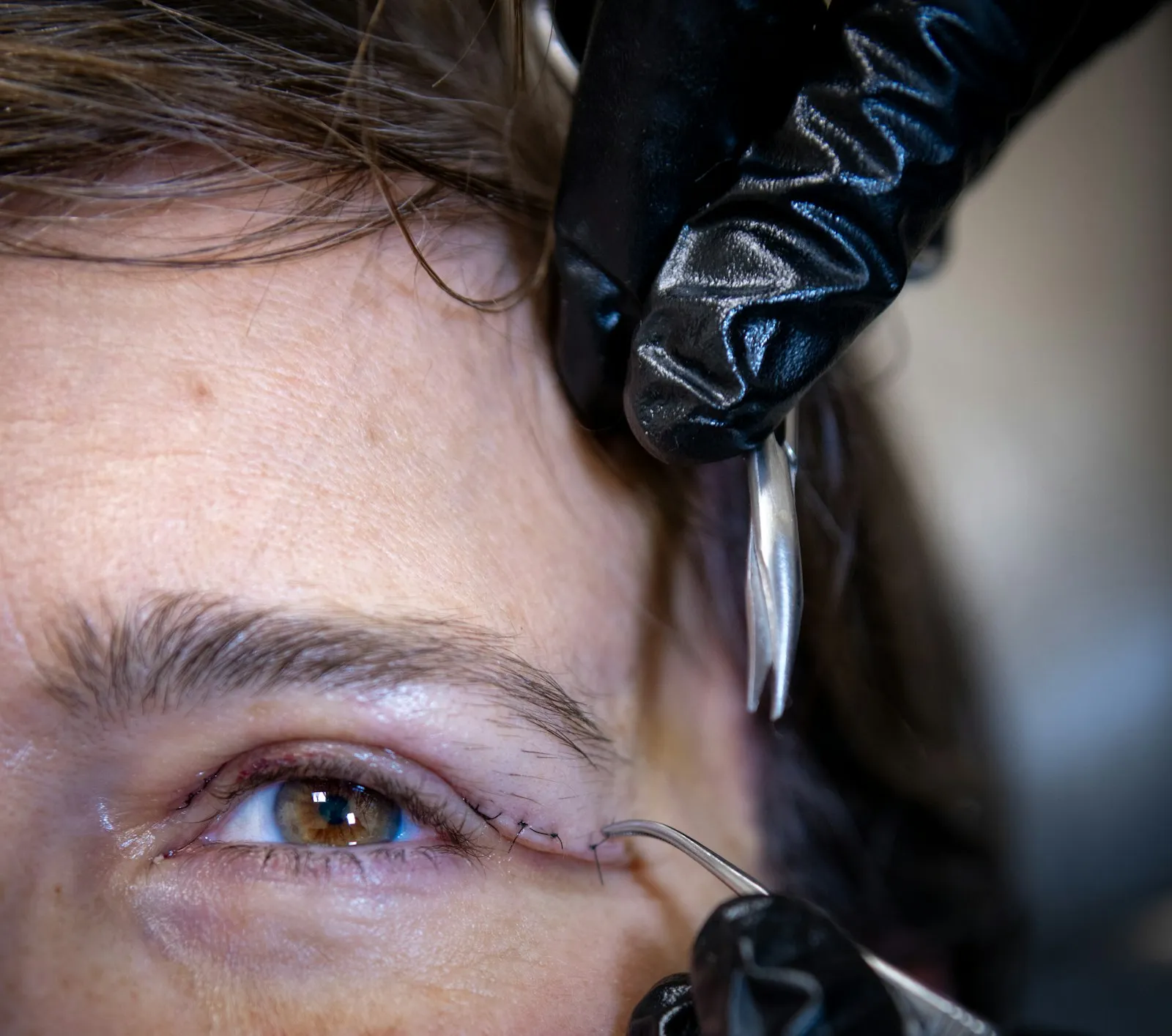
The visible recovery and the actual result are on different clocks. In one surgical protocol published in the World Journal of Plastic Surgery, stitches and the external splint were removed on the seventh day and nasal taping was continued for three months. That was a single centre’s practice, not a rule, and schedules differ between surgeons. Ask what yours will be.
The swelling runs far longer than the splint. A three-dimensional photographic study of 18 patients undergoing primary open rhinoplasty found that nasal volume reached its maximum 7 to 14 days after surgery, then declined by a mean of 2.8 millilitres between day 7 and beyond day 250. Tip projection fell and nasal width increased progressively between day 7 and day 90, with near resolution only past 250 days. The study is small, and it measures volume rather than appearance. Its practical point survives the caveats: the nose you photograph when the splint comes off is not the nose you are buying, and neither is the one you photograph at three months.
That matters for travel. Plan the trip around the parts of recovery that need a surgeon in the same city — the splint, the stitches and the first follow-up — and expect the assessment of the result to happen by correspondence, months later, from wherever you live.
Five questions that change what you are quoted
Take these to the consultation
1. Which material do you intend to use, named, and what is the plan if there is not enough septal cartilage once you are operating?
2. Is the operating surgeon a board-certified plastic surgery specialist, and will that same person perform every part of the procedure?
3. General anaesthesia or sedation, and is a separately qualified anaesthetist present throughout?
4. If I am unconscious, will the operating-room CCTV be recording, and how do I make that request?
5. What is the written policy on revision — who decides, at whose cost, and within what period?
The CCTV question is a legal right rather than a favour. Article 38-2 of the Medical Service Act took effect on 25 September 2023 and requires operating-room cameras where patients are rendered unconscious, as the Korea Times reported at the time. Recording is not automatic. The patient or guardian has to ask for it, and footage is kept for at least 30 days. If your rhinoplasty is under sedation rather than general anaesthesia, the requirement may not attach at all, which is itself worth clarifying before the day.
If something does go wrong, the Korea Medical Dispute Mediation and Arbitration Agency handles medical disputes, is open to foreign nationals, aims to conclude cases in around 90 days, and produces mediation agreements with the effect of a court settlement. Its free consultation line is 1670-2545, weekdays 09:00 to 18:00. Note the number before you travel, not after.
Before you book
Look up the clinic’s declared prices on the HIRA database, then ask for the itemised quotation and compare the two. Read our guide to what plastic surgery costs in Korea for how non-covered pricing works across procedures, and what ghost surgery is and how to ask about it before you agree to anything. The pre-booking checklist collects the questions on this page into something you can print.
Sources
- Prevalence of complications associated with polymer-based alloplastic materials in nasal dorsal augmentation: a systematic review and meta-analysis. Maxillofacial Plastic and Reconstructive Surgery. Read 21 Sept 2026.
- Problems Associated with Alloplastic Materials in Rhinoplasty. Yonsei Medical Journal. Read 21 Sept 2026.
- Rib Grafts in Rhinoplasty: A Systematic Review and Meta-analysis of Autologous, Fresh-frozen, and Irradiated Cartilage. Plastic and Reconstructive Surgery – Global Open. Read 21 Sept 2026.
- Discovering the True Resolution of Postoperative Swelling After Rhinoplasty Using 3-dimensional Photographic Assessment. Plastic and Reconstructive Surgery – Global Open. Read 21 Sept 2026.
- Evaluation of Clinical Outcomes and Satisfaction of Rhinoplasty with or without Smasectomy with the Aim of Thinning the Nasal Tip in Patients with Thick Nasal Skin. World Journal of Plastic Surgery. Read 21 Sept 2026.
- Non-covered treatment cost information (비급여 진료비용 정보). Health Insurance Review and Assessment Service. Read 21 Sept 2026.
- When beauty turns fatal: Korea logs 50 plastic surgery deaths since 2016. The Korea Herald. Read 21 Sept 2026.
- Patients, doctors at loggerheads as operating room CCTV footage made mandatory. The Korea Times. Read 21 Sept 2026.
- Korea Medical Dispute Mediation and Arbitration Agency. K-MEDI. Read 21 Sept 2026.
The Korea surgery planning checklist
One page: the licences to check, the questions to ask in a consultation, what to put in writing, and how long to keep the week free afterwards. Free, and we send it once.
The checklist goes out by email. Until the list opens, write to [email protected] and we will send it back by hand.
Photograph by SUN STUDIO CREATIVE / Unsplash